Boys' School Shoes by Age: What to Look for at 4, 7, 11 and 14
Updated on:
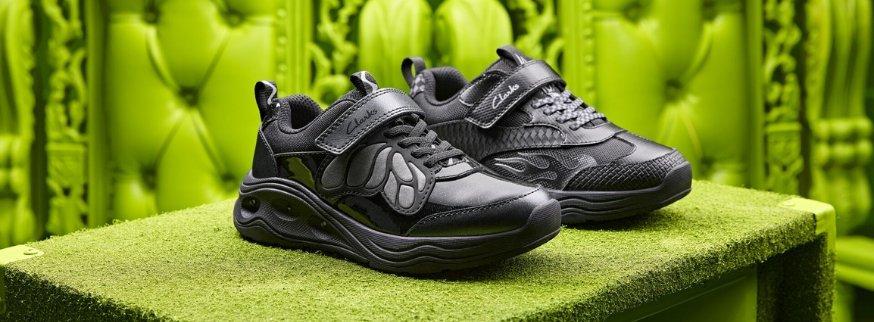
Finding the best boys' school shoes is not just about picking the right size and hoping they last. A four-year-old starting Reception needs something very different from a fourteen-year-old who is already moving through school with more independence, stronger opinions and near-adult feet.
That is why age matters. Not because every child grows in exactly the same way, but because each stage brings different school days, different fit questions and different priorities. At four, easy fastenings and growing room may be front of mind. At seven, durability and playground comfort become bigger concerns. At eleven, uniform rules and the move to secondary school often shape the choice. By fourteen, comfort still matters, but style preference is harder to ignore.
Clarks brings 200 years of children’s footwear knowledge to these decisions, alongside biomechanics research informed by 1,200 3D foot scans, width fittings, in-store fitting services and the Fit Guarantee. So if you are browsing boys' school shoes, this guide breaks down what to look for at each stage, so you can choose with more confidence.
Key Takeaways
- Boys’ school shoes need to change with age, so the right pair at four will not always be right at seven, eleven or fourteen.
- At age four, easy fastenings, growing room and a secure fit are usually the main priorities.
- At age seven, durability, scuff resistance and all-day comfort become more important as school days get busier.
- At age eleven, secondary school expectations often mean smarter black leather styles and more lace-up options.
- At age fourteen, many boys want school shoes that balance comfort, durability and a more grown-up look.
- Sizing by age can help as a rough guide, but measuring length and width gives a clearer answer.
- Clarks’ fit expertise, width fittings and measuring support can help parents choose school shoes that work for the child, not just the age.
Age 4: Starting Reception
By age four, most boys are wearing somewhere around a UK size 7 to 10 in the infant range, though every child grows at their own pace. That matters because Reception is often the first time school shoes become part of a full weekly routine. Shoes are no longer just for short outings or family days. They are worn for long school days, playground time, sitting on the carpet, walking in lines, running outside and learning to do things more independently.
At this stage, easy fastening is usually one of the most practical features. Velcro straps often make more sense than laces because they help children manage their shoes with less adult help. A secure fastening also supports a better fit through the day, especially when children are moving between classroom activities and outdoor play.
Growing room is important too, but it needs to be the right kind of room. Shoes that are too tight can become uncomfortable quickly, while shoes that are too large can slip, rub or make movement feel awkward. This is where a proper fitting can make a real difference, especially for a first pair of school shoes.
Width also deserves attention. Children’s feet are not all the same shape, and a size alone will not always tell the full story. Clarks offers width fittings including Narrow, Standard, Wide and Extra Wide, helping parents find a fit that feels secure without unnecessary pressure.
For many parents, this is the stage where in-store fitting feels most reassuring. A trained fitter can check length, width and overall comfort, and help you understand whether the shoe has enough growing room for everyday school wear.
If you are shopping for this stage, primary school shoes for boys are a useful place to start. If you want to keep track of changes at home between fittings, kids' foot measuring gauges can also help make regular checks feel less like guesswork.
Age 7: Mid-Primary, Year 2 to Year 3
By age seven, most boys are typically wearing UK size 11 to 13 in the junior range, though variation is wide. At this stage, many children are established walkers and far more active through the school day. Their shoes have to work harder, not just fit properly at the start of term.
The school day usually includes classroom time, playground runs, wet mornings, scuffed toes, PE changes and plenty of movement between spaces. Clarks’ biomechanics research suggests children can take around 10,000 to 16,000 steps a day, which explains why durability becomes such a key part of the decision. School shoes are not sitting quietly under a desk all day. They are being used constantly.
For this age, parents often want shoes that can cope with active break times and still look school-ready. Reinforced toe boxes can help with scuff resistance, especially for boys who kneel, run, climb or drag their toes during play. Flexible TPR soles can support movement without feeling too rigid, while reflective details can be useful during darker winter mornings and after-school pick-ups.
Self-fastening is also developing at this stage. Some boys may still prefer Velcro, while others are ready to practise laces or move towards more grown-up fastenings. There is no single right answer. The best choice is the one your child can manage confidently while still meeting school requirements.
Odour control can also matter more as children get older and more active. Features such as Microban odour control are useful for school shoes worn five days a week, especially when shoes are doing long hours.
Parents may also be thinking about PE shoes separately. School shoes and PE trainers do different jobs, so it is worth checking what the school expects and whether a separate pair is needed for sports days, indoor PE or outdoor activities.
For this stage, primary school shoes for boys remain a strong starting point, while boys' school trainers can be useful when schools allow trainer-style options or when PE footwear is on the list.
Age 11: Year 6 to Year 7 Transition
By age eleven, most boys are usually wearing UK size 1 to 3, with feet that look very close to adult shape, though still growing. This is also one of the biggest school shoe transition points because the move from primary to secondary often brings new uniform expectations.
For many boys, this is the first time black leather lace-up shoes become the standard. Secondary schools may have stricter rules around colour, material and style, so parents often need to check the uniform list more closely than they did during primary school. A shoe that worked well in Year 6 may not meet the expectations of Year 7.
This is also the age when peer perception starts to matter more. The parent is still making the final decision, but many boys are beginning to care how their school shoes look. They may prefer something that feels more grown-up, less bulky or closer to what older pupils are wearing. The challenge is finding a pair that meets school rules, supports comfort and still feels acceptable to the child wearing it.
Longer school days can also change what shoes need to do. Secondary pupils may have a longer commute, move between more classrooms, carry heavier bags and spend more time walking around a larger school site. Durability becomes even more important, especially if the same shoes are worn every weekday.
Width remains relevant here too. A foot may look more adult, but it is still growing and changing. Measuring properly matters, especially if your child has moved quickly through sizes or seems between fits.
Some parents also consider a backup pair at this stage. That does not suit every budget, but it can be useful if shoes take a lot of wear or if the school week leaves little time to dry, polish or repair them.
For this transition stage, older boys' school shoes are a natural place to explore smarter options, while boys' school uniforms can help parents think about shoes alongside the wider return-to-school checklist.
Age 14: Established Secondary, Year 9 to Year 10
By age fourteen, most boys are typically wearing UK size 5 to 8 in youth sizing, with some boys already in adult ranges. Their feet may be close to adult size, but that does not mean growth is finished. Boys can continue growing through the teenage years, so checking fit still matters.
At this stage, school shoes need to do several things at once. They have to meet uniform expectations, last through a full school week, stay comfortable during long days and still feel right to an older boy who may have clear preferences. This is where the balance between comfort, durability and style becomes especially important.
Older boys often prefer sleeker leather lace-ups or smart finishes that look more grown-up. They may be less willing to wear anything that feels too young, too bulky or too different from what their friends are wearing. That does not mean parents have to compromise on quality or fit. It simply means the shoe has to work for both the school rules and the person wearing it.
Long commutes and active teen feet make comfort important. Microban odour control can be useful for shoes worn all week, while supportive soles and durable uppers help shoes handle daily wear. Reinforced areas still matter too, even if the shoe looks more grown-up.
Some boys at fourteen may be ready to move into adult ranges, while others remain in youth sizes. Either way, measuring is still worth doing. A near-adult foot can still change quickly enough to affect comfort.
How to Choose the Right Size: A Quick Sizing Guide
A kids' foot size chart can be helpful when you want a general sense of where your child might sit by age, but it should never replace measuring. Boys’ feet do not grow on a fixed timetable, and two children of the same age can wear very different sizes.
That is why fit should come before assumptions. Age gives you a starting point. Measuring gives you the answer. Length matters, but width matters too. A shoe can be the right length and still feel uncomfortable if it is too narrow or too wide.
Clarks width fittings are designed to help with this. Narrow, Standard, Wide and Extra Wide options mean parents can choose more precisely than size alone allows. This is especially useful for school shoes because children wear them for long hours and need them to feel secure through different kinds of movement.
At-home measuring can be a practical way to check between fittings. If shoes suddenly seem tight, your child complains about pressure, or there has been a visible growth spurt, it is worth measuring again rather than waiting for the next school shopping trip.
For home checks, kids' foot measuring gauges can help parents measure more consistently, while the school shoe size calculator can support the next step once you have the measurements. If you are unsure, an in-store fitting can help confirm the best size, width and fit.
What to Look for in Boys’ School Shoes, Whatever the Age
The best boys’ school shoes will look a little different at each age, but some features matter right across the four-to-fourteen window.
Quality leather uppers are often a good starting point because school shoes need to handle daily wear, scuffs, wet weather and regular cleaning. Leather can also offer a smart finish that works with most UK uniform expectations.
Microban odour control can be useful for shoes worn all day, five days a week. Flexible but supportive soles help children move comfortably, whether they are in Reception or secondary school. Reinforced toe boxes can help with scuff resistance, especially for younger boys who are hard on their shoes.
Reflective details can be useful during darker mornings and winter journeys home. Built-in growing room matters too, but it should be properly checked. Too much room can be just as unhelpful as too little, because the foot may slide inside the shoe.
Width fittings remain important at every age. Boys’ feet can change shape as well as size, and a secure width fit can make school shoes feel much better through a full day.
The Clarks Fit Guarantee can offer added reassurance after an in-store fitting. If shoes fitted in-store do not continue to fit within three months, free exchanges may be available under the guarantee terms. That kind of support is useful because children’s feet can change quickly, especially in younger years.
School shoes are usually the main footwear investment for the start of term, but parents are often thinking about the wider kit at the same time. It can be useful to plan shoes alongside school bags & accessories, especially when you are trying to get everything ready without leaving small essentials to the last minute.
Black School Shoes for Boys: The Standard Uniform Choice
For many UK schools, black leather is still the standard uniform choice. If you are searching for black shoes for school boy options, it is worth checking both the school’s rules and your child’s age before choosing a pair.
For younger boys, black school shoes often mean Velcro fastenings, rounded shapes and reinforced areas that can cope with active play. The shoe needs to be smart enough for uniform, but still practical for Reception and primary school routines.
For older boys, black leather lace-ups are often more common. They tend to feel more secondary-school appropriate and may better match stricter uniform policies. Sleeker finishes can help older boys feel more comfortable with the look, while still keeping the shoe school-ready.
Maintenance matters too. A quick polish can help leather shoes stay presentable, while drying wet shoes properly can support longer wear. It is better to let shoes dry naturally rather than placing them directly against strong heat, which can affect the material.
Parents often wonder when to repair and when to replace. Minor scuffs or light wear can usually be managed with care, but separated soles, broken uppers or heels worn through are stronger signs that a replacement is needed. If the shoe no longer fits properly, replacement is the safer answer.
When to Replace School Shoes?
Knowing when to replace school shoes can be just as important as choosing the first pair. Children do not always complain clearly, and shoes can look acceptable from the outside while no longer fitting properly.
Fit signs are the first thing to watch. Toe-end pressure, heel slipping, redness after wear, rubbing, complaints of pinching or a child suddenly resisting a pair they used to wear happily can all suggest the shoes need checking. If your child says their shoes feel tight or uncomfortable, take it seriously and measure again.
Structural wear matters too. A separated sole, broken upper, worn-through heel or shoe that no longer holds its shape properly may not support the foot as it should. School shoes work hard, and visible damage is not only a style issue. It can affect comfort and movement.
The replacement cycle varies by age. Younger children may outgrow shoes more quickly, sometimes before the shoe itself has worn out. Older children may stay in a size longer, but their shoes may take heavier daily wear through commuting, longer days and more independent movement.
Mid-term replacement is normal for fast-growing feet. It does not always mean the first pair was wrong. It may simply mean the child has grown, the school routine is demanding, or the shoes have done their job for as long as they reasonably can.
Choosing Boys’ School Shoes With Confidence
Choosing boys’ school shoes becomes easier when you stop treating every age the same. A four-year-old starting Reception needs easy fastenings, growing room and a secure fit. A seven-year-old needs durability for busy primary days. An eleven-year-old may need a smarter black lace-up for the move to secondary. A fourteen-year-old may want something that feels more grown-up while still working for school rules.
The right shoe depends on the right child at the right stage. Age can guide the decision, but measuring, fit and school requirements should shape the final choice.
That is where Clarks’ fit expertise can help. With width fittings, measuring tools, in-store fitting and children’s foot health knowledge, parents have more than guesswork to rely on. And when shoes are worn all day, five days a week, that reassurance matters.
FAQs About Choosing Boys’ School Shoes
What Size School Shoes Does My 4 Year Old Boy Need?
By age four, many boys are somewhere around a UK size 7 to 10 in the infant range, but every child grows differently. Measuring length and width is the best way to choose the right fit, rather than relying on age alone.
What Are the Best School Shoes for Boys Starting Reception?
For boys starting Reception, look for school shoes with easy fastenings, a secure fit, enough growing room and durable materials that can handle active days. Velcro fastenings are often helpful because they support independence.
Are Leather or Velcro School Shoes Better for Boys?
Leather and Velcro do different jobs. Leather is often a good choice for durability and uniform expectations, while Velcro is useful for younger boys who are still learning to fasten shoes independently. Many younger school shoes combine both.
How Often Should I Replace My Son’s School Shoes?
It depends on his age, growth and how much wear the shoes get. Younger children may need replacing more often because their feet grow quickly, while older boys may wear shoes out through longer school days and commutes.
Do Boys Need Wide-Fit School Shoes?
Some boys do. Width matters as much as length because a shoe that is too narrow or too wide can feel uncomfortable even if the size number looks right. Clarks offers width fittings to help match different foot shapes.
What’s the Best Black School Shoe for an Older Boy?
For an older boy, a black leather lace-up is often a practical choice because it usually meets secondary school uniform expectations and feels more grown-up. Look for comfort, durability, a secure fit and a finish that suits the school rules.
How Can I Check My Son’s School Shoes Fit Properly?
Look for enough room at the toes, a secure heel, no rubbing or redness and no pressure across the foot. If your child complains about pinching, takes the shoes off quickly or seems reluctant to wear them, measure again.
When Should Boys Move From Velcro to Laces for School Shoes?
There is no fixed age. Many boys move from Velcro to laces when they can tie them confidently and when school expectations become more formal, often around the move into later primary or secondary school.